

Compliance requirements your engineers and AI agents can actually implement.
Implement regulations faster, with less manual work.
A regulatory obligation is not an implementation requirement.
Doing this manually is slow and requires specialist expertise.
High-performance teams need structured requirements, mapped controls, and evidence expectations - ready for implementation
Your team gets engineering work, not legal text.
A regulation arrives as modules. Each module is a unit of work you can hand to a person, with the control that satisfies it and the evidence that defends it already attached.
GDPR requirements
The evidence exists before anyone asks for it.
The requirement, the evidence submitted against it, and its review status stay connected from the day the work is defined.
A request for proof can pull engineers back into old work: searching tickets, locating configuration records, reconstructing decisions. RuleMesh establishes what evidence is expected as the work is defined. Agents submit evidence. A person reviews it.
How a regulation becomes work, and work becomes evidence.
Each requirement tells you what to put in place, and what to keep as proof.
Delivered into the tools your team already works in.
The Jira app is live; we are building more issue or project integrations.
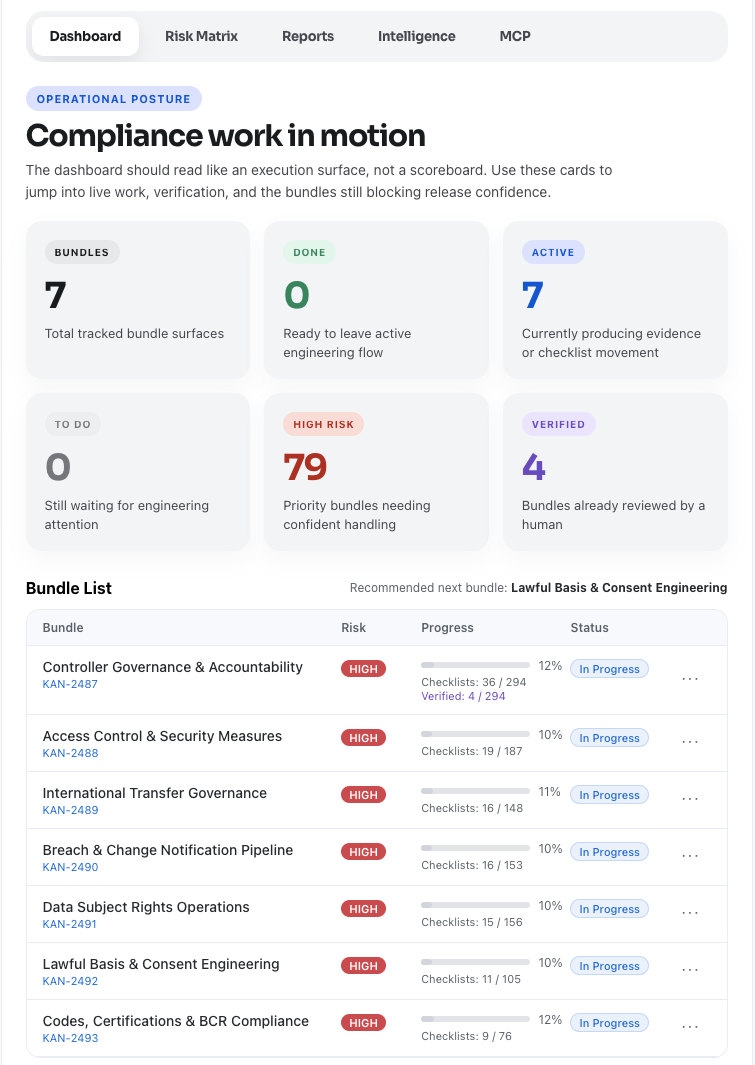
Showing Jira dashboard: Dashboard overview
RuleMesh for Jira screenshots. Illustrative data.
 View the app on the Atlassian Marketplace
The Jira app is live
Findings arrive as tickets carrying the requirement, its citation, and the evidence checklist that closes it.
Works with your existing tools
Engineers do not want another dashboard. The work lands in the tracker your team already runs, and the evidence stays attached to it.
The security work you already do counts toward the regulation.
Requirements arrive mapped to controls your team already implements and audits against. Cloud security controls for AWS, Azure and GCP apply across the catalog; each released regulation lists the frameworks it maps to.
An open protocol for machine-verifiable compliance exchange.
RuleMesh structures the work inside an organisation. HCAP is our open protocol proposal for exchanging compliance information across system and organisational boundaries.
Start with scope, terms, or the regulation itself.
Use these reference surfaces when you need applicability and definitions before implementation.
What Applies To Me
A guided scope interview backed by the RuleMesh rules engine. Answer a few plain-English questions; get your role, what specifically applies, and the verbatim article text for every conclusion.
Open the checker→This page is also published for machine readers: rulemesh.com/index.md
Latest reports and analysis
Written by the team building RuleMesh and updated as we publish. Older pieces are in the library.
The EU AI Act and GDPR: two regulations, one system, one set of design decisions
Analysis · EU AI Act and GDPR · 11 October 2026 · 8 min read
One set of controls can meet both GDPR and the AI Act, if the decisions are made at design time. Most GDPR work carries across only in part, leaving gaps in purpose and access records.
Your team can get started straight away with the AI agents they already use.
It's free to get started. See the evidence before you decide.