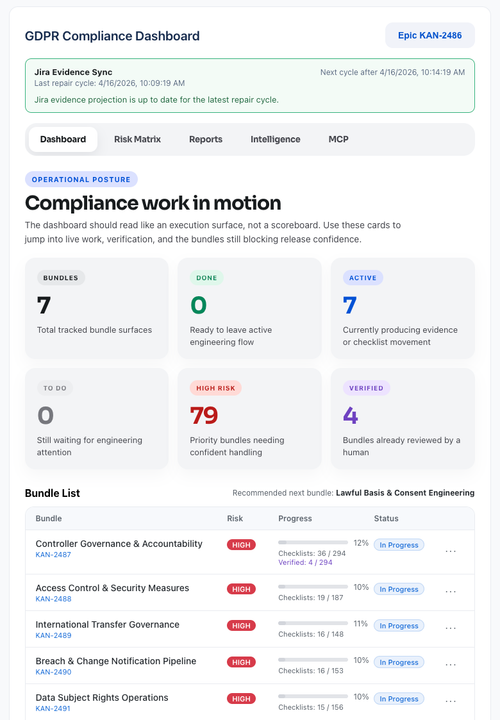
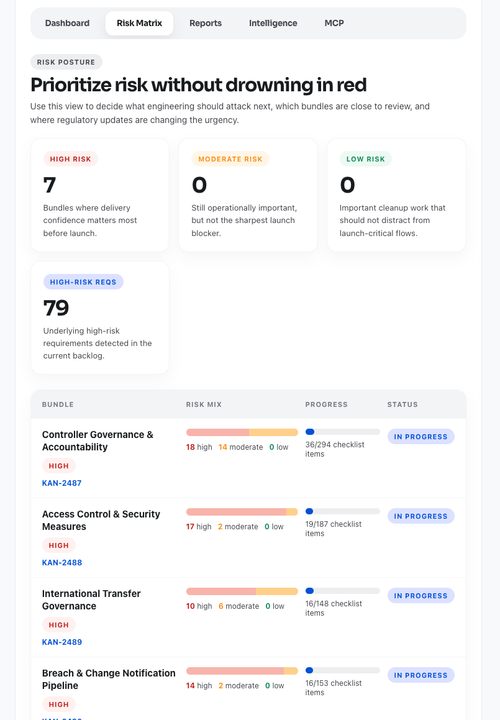
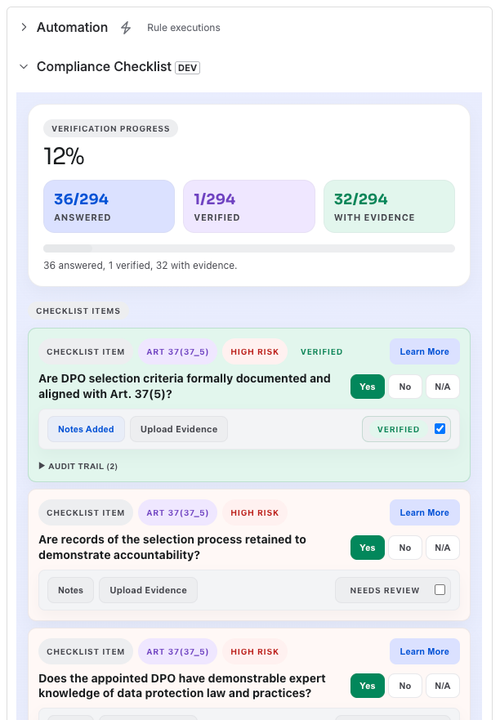
GDPR requirements your engineers and AI agents can actually implement.
RuleMesh defines what to implement across your cloud infrastructure, how to execute it with framework-specific controls, and what evidence proves it was done — ready for engineers and AI agents.
credit_card_offFree to start. Account required for an API key. RuleMesh never accesses or uploads your source.
Not sure what GDPR requires from you?Find out in 2 minutes→
The missing layer between the policy and the system.
Legal teams read the law. Engineering teams build the system. Auditors verify after the fact. The technical specification that should connect those three usually does not exist.
RuleMesh defines the requirement from source law, maps it to the control pattern the team should implement, and specifies the evidence a reviewer will expect before the audit starts.
What the law requires
A structured requirement with citation back to the GDPR article and paragraph. When someone asks where it came from, the answer is the source text.
What engineering should do
The control pattern that satisfies the obligation, mapped to the cloud and security frameworks your team already uses.
What evidence proves it
The artefact, log, configuration, or attestation a reviewer will expect to see. The evidence is specified before the work starts, not reconstructed later.
From one MCP command to a shareable evidence signals report.
Four steps. Minutes apart. Your agent reads the repository. RuleMesh does not.
Connect your agent
Works with Claude Code, Codex, Gemini CLI, Cursor, and other Streamable HTTP MCP clients.
→Evaluate your repository
Your coding agent reads the repository in its own environment and compares the relevant files with RuleMesh requirements and evidence criteria.
→Generate the evidence signals report
The output shows what was found, what is partial, and what is missing across the relevant GDPR modules.
→Track the work in your issue tracker
The Jira app is live; we are building more issue or project integrations.
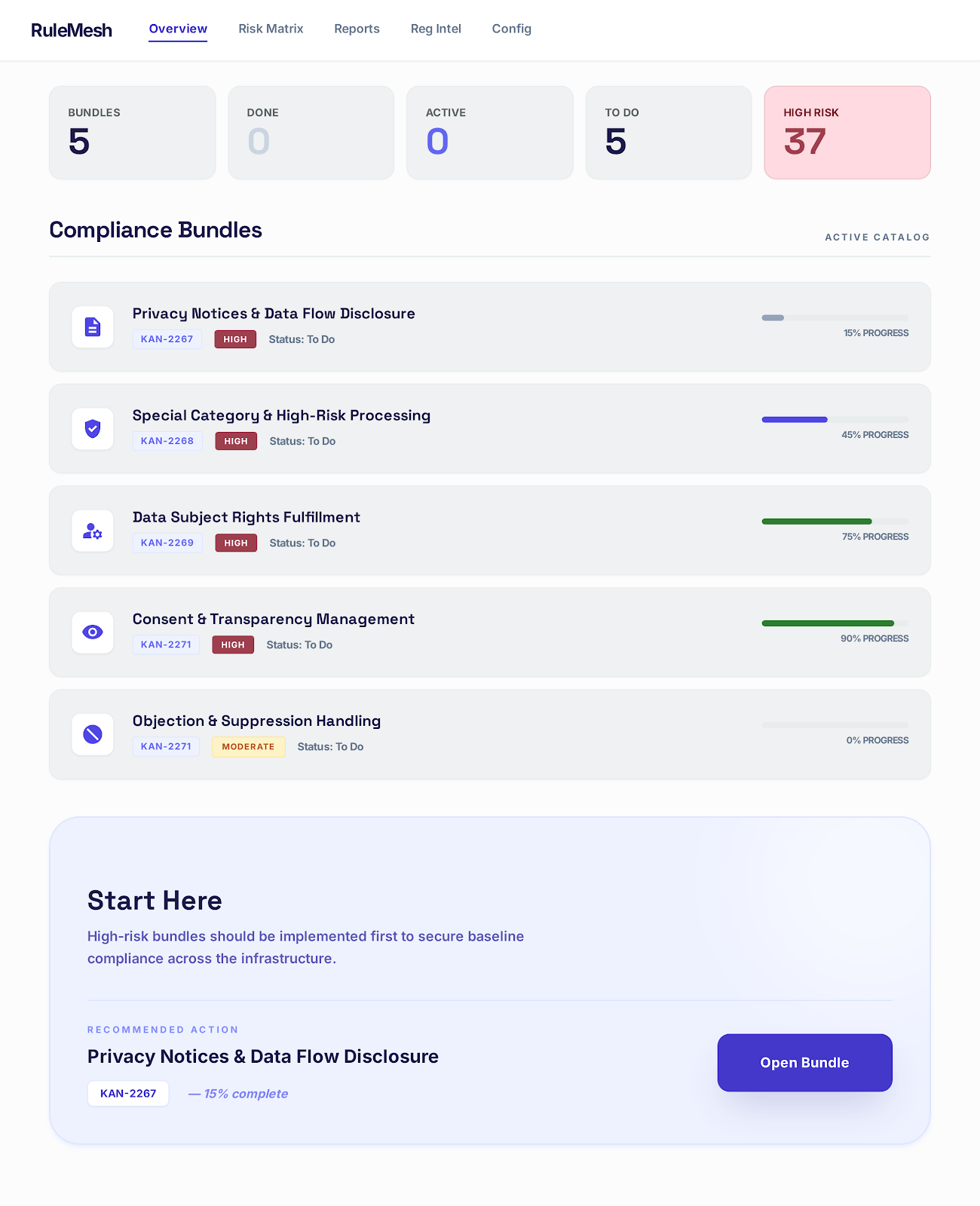
Turn evidence signals into verified engineering work.
Jira integration (live)one of several surfaces
The agent evaluates the repository in its own environment and routes findings into Jira tickets — module coverage, checklists, and evidence tracking where your team already works. The Jira app is live; we are building more issue or project integrations.
Works with your existing toolsno new dashboard
Engineers do not want another dashboard. The Jira app is live; we are building more issue or project integrations.
Privacy by designsource boundary · file names only
Your coding agent reads your source. RuleMesh does not. The agent reports evidence signals and the file names where signals were detected.
191 GDPR requirements. 7 engineering modules.
The obligations GDPR places on an organisation, engineered into structured requirements mapped to cloud controls, security frameworks, and evidence checklists.
Start from the regulation surface when the question is scope, terms, or next actions.
These pages are for teams working out applicability, definitions, and obligation scope before implementation begins.
What Applies To Me
A guided scope interview backed by the RuleMesh rules engine. Answer a few plain-English questions; get your role, what specifically applies, and the verbatim article text for every conclusion.
Start the interviewarrow_forwardGDPR Hub
Use the engineering-facing read of GDPR to understand scope, key terms, and the obligation clusters that matter first.
Open surfacearrow_forwardAI Act Hub
Get the terms, roles, and value-chain obligations that shape how AI systems are built, shipped, and governed.
Open surfacearrow_forwardWe are not building another compliance portal.
RuleMesh engineers cited obligations into structured rules systems can act on. We are also authoring HCAP, an open protocol for machine-verifiable compliance between systems. The point is larger than document management: compliance should move out of paper policies and into the infrastructure itself.
Inside the company
RuleMesh helps teams implement requirements, map them to controls, and produce evidence signals in the workflow they already use.
Between companies
HCAP is the protocol layer for proving compliance posture across API and organizational boundaries without relying on email chains, questionnaires, and static agreements.
Open by design
HCAP is an IETF draft because compliance infrastructure should be interoperable. We would rather help define the category than trap verification inside a vendor-owned service.
Agent-Agnostic Compliance: how three AI models interpret identical regulatory data via MCP.
Our technical study explores the elimination of “agent drift” in regulatory mapping. Using structured MCP servers, we achieved consistent compliance coverage across Claude, Gemini, and GPT.
Read the White Paper→Connect your coding agent first. See what it reports back.
Connect RuleMesh to your coding agent and review the evidence signals from your own repository, against real GDPR requirements.